Why Your Coaching Funnel Has a Leaky Middle: The 3-Step Fix for Converting More Leads
Direct Answer: Your coaching funnel is losing revenue in the middle—between opt-in and the sales call—because there’s a trust gap that most funnels don’t bridge. Leads know you exist but don’t trust you enough to invest $3K–$20K. Fix this with three systems: a Conviction Bridge (7–14 days), micro-commitments (small actions that build investment), and an extended follow-up funnel (60+ days with behavioral segmentation).
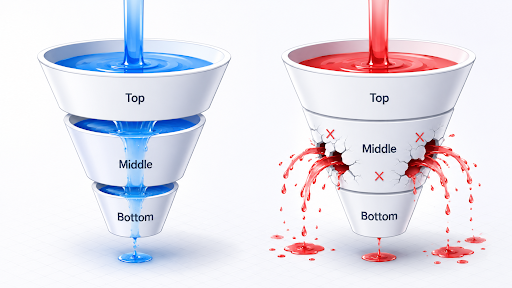
The Core Problem: What Is a Leaky Middle Funnel?
Definition: A leaky middle funnel is when leads opt in, show initial interest, and then disappear before reaching the sales call or purchasing stage. They don’t fail to opt in (top funnel) or fail to close (bottom funnel)—they vanish in the middle stretch.
What a Leaky Middle Looks Like (4 Common Patterns)
- The Ghost Subscriber: Downloaded your lead magnet, opened one email, never engaged again. Technically on your list. Functionally gone.
- The Silent Webinar Registrant: Signed up with intention but watched zero minutes and received no meaningful follow-up.
- The Warm-Then-Cold Lead: Engaged with your content for weeks. You invited them to book a call. They went silent.
- The Perpetual “I Need to Think About It”: Got on your call, loved you and the program, then disappeared into the follow-up void.
Why This Costs You
The Math: If your coaching packages are $3K–$20K and you’re losing 60–70% of leads in the middle before they reach a sales call, that’s thousands of dollars per lead going unrealized. Most coaches fix the wrong problems (traffic, lead magnets, close rate) and ignore the broken middle.
Why the Middle of Your Funnel Leaks: The Root Cause
Root Cause: Most coaching funnels have a trust gap. Leads know you exist and liked something enough to opt in. But they don’t yet trust you enough to pay for high-ticket coaching. The middle of your funnel asks them to cross a massive leap—from stranger to someone investing thousands—without enough runway to build conviction.
The Typical Broken Funnel Structure
Most coaching funnels look like this:
- Lead Magnet (PDF, guide, checklist)
- Email Sequence (3–5 automated emails)
- Sales Call (book a call with me)
The Problem: This three-step structure is too thin. There’s not enough substance, proof, or relationship-building between opting in and being asked to invest.
What the Middle of Your Funnel Must Do
Systematically convert interest into conviction. Not hype. Not “warm leads.” Move prospects from “this is interesting” to “this coach understands my problem better than anyone and I believe they can help me solve it.”
What a Leaky Middle Looks Like (4 Common Patterns)
- The Ghost Subscriber: Downloaded your lead magnet, opened one email, never engaged again. Technically on your list. Functionally gone.
- The Silent Webinar Registrant: Signed up with intention but watched zero minutes and received no meaningful follow-up.
- The Warm-Then-Cold Lead: Engaged with your content for weeks. You invited them to book a call. They went silent.
- The Perpetual “I Need to Think About It”: Got on your call, loved you and the program, then disappeared into the follow-up void.
Why This Costs You
The Math: If your coaching packages are $3K–$20K and you’re losing 60–70% of leads in the middle before they reach a sales call, that’s thousands of dollars per lead going unrealized. Most coaches fix the wrong problems (traffic, lead magnets, close rate) and ignore the broken middle.
The 3-Step Fix: How to Plug the Leaky Middle
Step 1: Install a Conviction Bridge (Days 1–14)
What It Is
A Conviction Bridge is a deliberately designed 7–14 day sequence of content and touchpoints that deepen belief at each stage. It sits between your lead magnet and
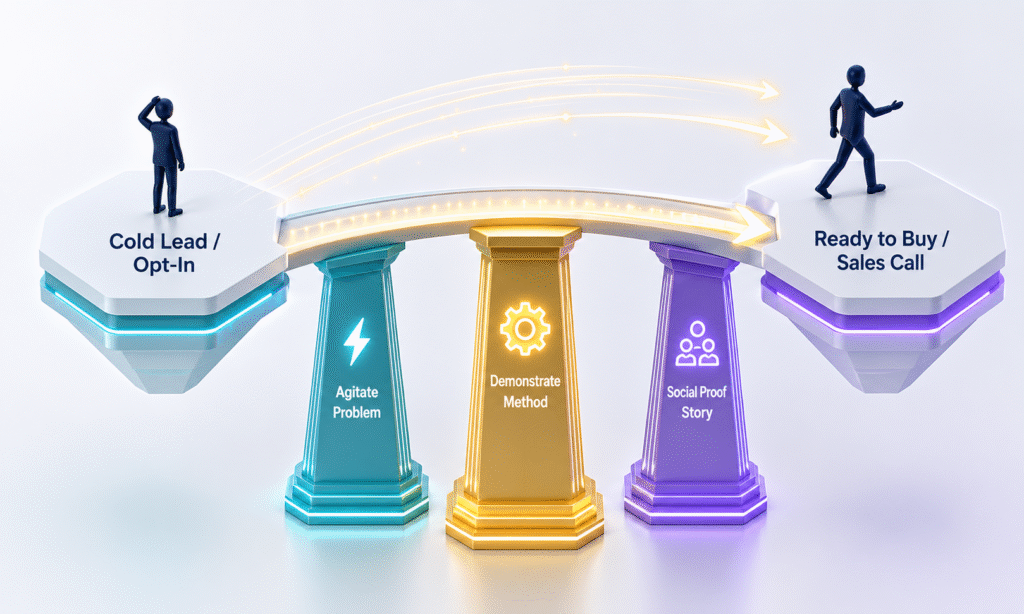
How It Works: The 3-Part System
Agitate the Problem (Days 1–5): Help your lead feel viscerally the cost of staying stuck. Not manipulation—diagnosis. Share targeted insights about the exact pain your ideal client is experiencing. Use emails, short videos, or case study snippets that prove you understand their world.
Demonstrate Your Method (Days 6–10): Reveal not just what you coach on, but how you coach. Show your process, framework, or unique point of view. When leads understand your method, they’re not buying a vague promise—they’re buying a system they’ve already started believing in.
Build Social Proof Through Story (Days 11–14): Use transformation stories woven into your middle-funnel content. Not testimonials at the bottom of a sales page. Real stories that let leads see themselves in your past and current clients.
Conviction Bridge Content Examples
- Email series with targeted diagnosis of specific pain points
- Short 5–10 minute video series explaining your method
- 2–3 detailed case studies showing the before/after of your clients
- Free mini-training or workshop (60–90 minutes)
Goal
Make the decision to work with you feel inevitable, not forced.
Step 2: Add a Micro-Commitment Mechanism (Days 8–14)
What It Is
Micro-commitments are small, low-friction actions that progressively increase a lead’s investment in the process. Each action slightly rewires their identity—they stop being “someone who downloaded a freebie” and become “someone actively solving this problem.”
Why It Works: Psychology of Consistency
Human psychology is wired for consistency. Once someone takes a small action, they’re far more likely to take the next bigger one. Each micro-commitment increases their skin in the game.
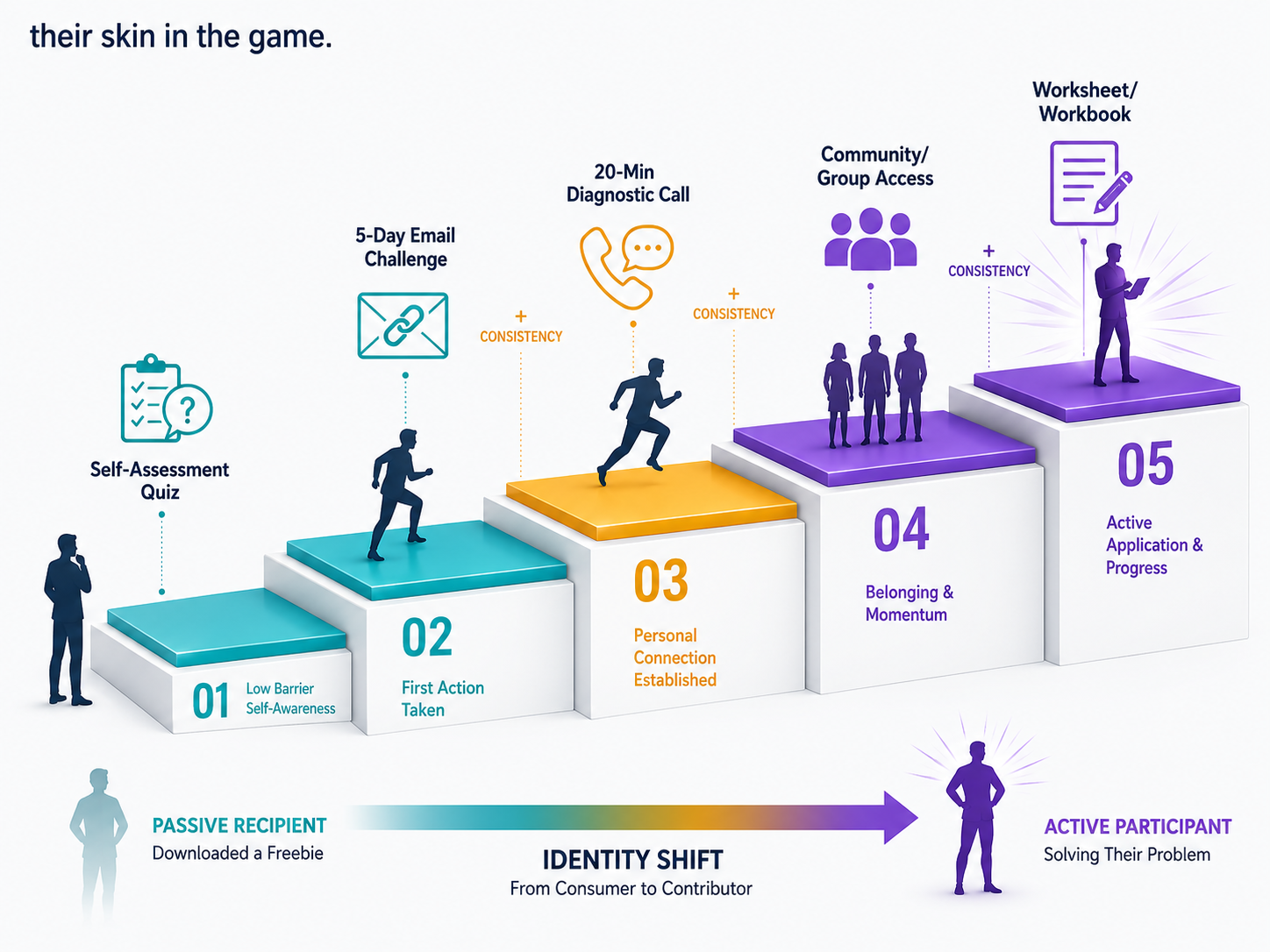
Micro-Commitment Mechanisms (Choose 1–2)
Self-Assessment or Quiz: A short 3–5 question assessment that delivers a personalized result. Instantly makes them feel seen and increases curiosity.
- 5-Day Email Challenge: One daily email with a small action to take (reflects on a specific question, tries a technique, fills out a worksheet). Builds momentum through daily engagement.
- Free Diagnostic Call (20 minutes): Lower commitment than a full sales call. They get tactical feedback. You get to understand their situation. Both parties invest time.
- Free Community/Slack Group Access: They engage with other leads and past clients before buying. See the community in action. Reduces fear of buying.
- Workbook or Worksheet: Ask them to map their current situation, goals, and objections. Writing commits them cognitively to the process.
Step 3: Create a Follow-Up Funnel That Actually Follows Up (Days 15–60+)
The Unsexy But Most Impactful Fix
Research Finding: B2B and high-ticket purchases require 7–13 touchpoints before a decision. The average coaching funnel gives up after 3–4 touchpoints. You’re leaving money on the table by stopping too early.
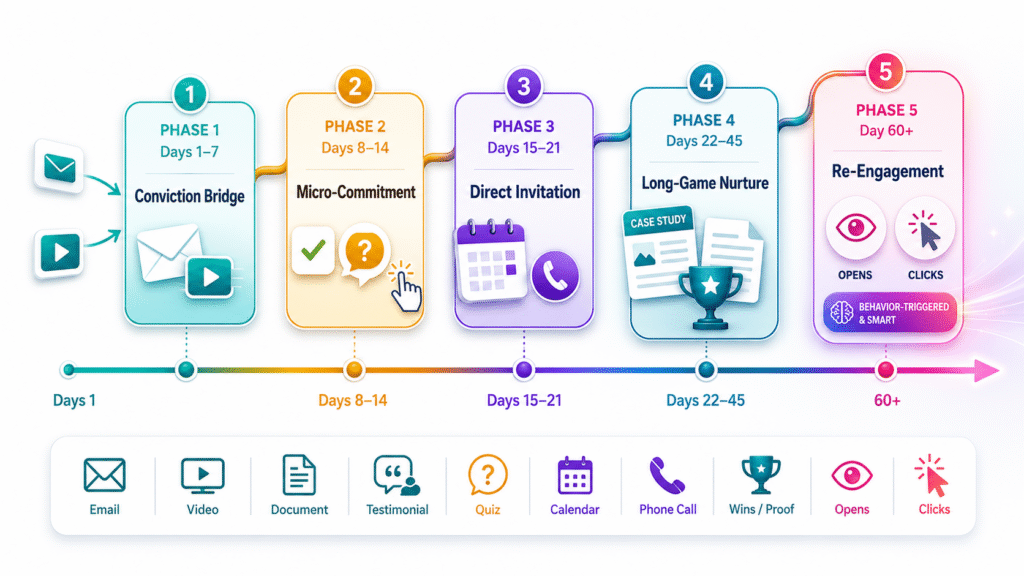
The Complete Follow-Up Funnel Timeline
- Days 1–7: Conviction Bridge content (Step 1 from above)
- Days 8–14: Micro-commitment mechanism (Step 2 from above)
- Days 15–21: Direct invitation to book a call, backed by objection-handling content (“What if it doesn’t work?” “Can I afford this?” “Do I have time?”)
- Days 22–45: Long-game nurture sequence with case studies, behind-the-scenes content, client wins, answers to the most common objections
- Day 60+: Re-engagement sequences triggered by specific behaviors (emails opened, links clicked, revisited your sales page)
Your Coaching Funnel Doesn’t Have a Traffic Problem
It doesn’t have a close rate problem. It has a middle problem.
The top of your funnel gets attention. The bottom makes the ask. But the middle—where strangers become believers—is where most coaches silently hemorrhage revenue.
The Fix (Recap)
- Build a Conviction Bridge (7–14 days): Agitate pain, demonstrate your method, show social proof
- Add Micro-Commitments (Days 8–14): Quiz, challenge, free call, community access, or worksheet
- Extend Your Follow-Up (60+ days with behavioral segmentation): Run 7 phases of content tied to lead behavior, not just time
Impact of Fixing the Middle: Warmer discovery calls. Higher close rates. Lower cost per lead. Clients arrive pre-sold and excited, not skeptical and unsure.
The Game-Changer: Behavioral Segmentation
Do Not Treat All Leads the Same: Someone who clicked on your sales page three times is not the same lead as someone who hasn’t opened an email in two weeks. Use email automation tags and conditional logic to send the right content to the right lead at the right time.
Behavioral Segmentation Examples
- High-Engagement Lead: (Opened 5+ emails, clicked 3+ links) → Send objection-handling content + direct call invitations
- Moderate-Engagement Lead: (Opened 2–4 emails) → Send more educational, trust-building content before asking for a call
- Low-Engagement Lead: (Opened 0–1 email) → Re-engage with a high-value piece of content (case study, video) before pushing for a call
- Sales Page Visitor: (Clicked to your sales page but didn’t book) → Send objection-handling content + social proof + a gentle re-invitation
Setup Requirements
Use automation tags in your email platform (ConvertKit, ActiveCampaign, HubSpot, Flodesk, etc.) to segment leads by behavior. This isn’t complicated. It just requires intentionality which most coaches skip.
Common Questions About Leaky Middle Funnels
Q1: How long should my Conviction Bridge be?
Answer: 7–14 days minimum. This gives you time to hit all three elements: agitate the problem (5 days), demonstrate your method (5 days), build social proof (4 days). Any shorter leads don’t have enough runway to build conviction.
Q2: What if my lead doesn’t take the micro-commitment?
Answer: That’s useful data. Leads who don’t engage with a micro-commitment are colder than those who do. Segment them accordingly send them more educational content before asking for a call. Or move them to a re-engagement sequence with a different hook.
Q3: How many emails is too many in a follow-up sequence?
Answer: There’s no upper limit as long as the content is valuable and segmented by behavior. Some coaches run 50+ day sequences because research shows high-ticket purchases need 7–13+ touchpoints. The key is segmentation—don’t send the same 50 emails to everyone.
Q4: Should I still run ads to cold traffic if my middle funnel is leaking?
Answer: No. Fix the middle first. Running more ads into a broken funnel is pouring more water into a broken bucket. Optimize your existing funnel’s conversion rate before scaling paid traffic.
Q5: What if leads book a call but don’t show up?
Answer: Add a pre-call sequence (2–3 emails in the 24–48 hours before the call) that confirms the call, builds anticipation, and asks them to prepare a question. This reduces no-shows by 20–30%.
The Bottom Line: Fix the Middle, Not the Traffic
Your Coaching Funnel Doesn’t Have a Traffic Problem
It doesn’t have a close rate problem. It has a middle problem.
The top of your funnel gets attention. The bottom makes the ask. But the middle—where strangers become believers—is where most coaches silently hemorrhage revenue.
The Fix (Recap)
- Build a Conviction Bridge (7–14 days): Agitate pain, demonstrate your method, show social proof
- Add Micro-Commitments (Days 8–14): Quiz, challenge, free call, community access, or worksheet
- Extend Your Follow-Up (60+ days with behavioral segmentation): Run 7 phases of content tied to lead behavior, not just time
Impact of Fixing the Middle: Warmer discovery calls. Higher close rates. Lower cost per lead. Clients arrive pre-sold and excited, not skeptical and unsure.
Implementation Checklist
☐ Audit your current funnel. Map out what happens between opt-in and sales call.
- ☐ Write your Conviction Bridge content (agitate pain, method, social proof). Schedule Days 1–14.
- ☐ Choose one micro-commitment mechanism (quiz, challenge, free call, community, or worksheet). Build it. Add it to Days 8–14.
- ☐ Map out your full 60+ day follow-up sequence. Segment by behavior (high engagement, medium, low, sales page visitors).
- ☐ Set up tags and conditional logic in your email platform to trigger the right content for the right leads.
- ☐ Test the funnel with your next cohort of leads. Track opens, clicks, booking rate, and close rate.
- ☐ Refine based on data. Which days convert best? Which micro-commitment has highest completion? Double down on what works.