
Most “growth experts” will tell you that if your ads aren’t performing, you need better creatives, more hooks, or a higher daily budget.
They are lying to you.
Scaling a broken math equation doesn’t lead to growth; it leads to bankruptcy. If your Return on Ad Spend (ROAS) is negative, the problem is rarely your Facebook Pixel…it’s your business model.
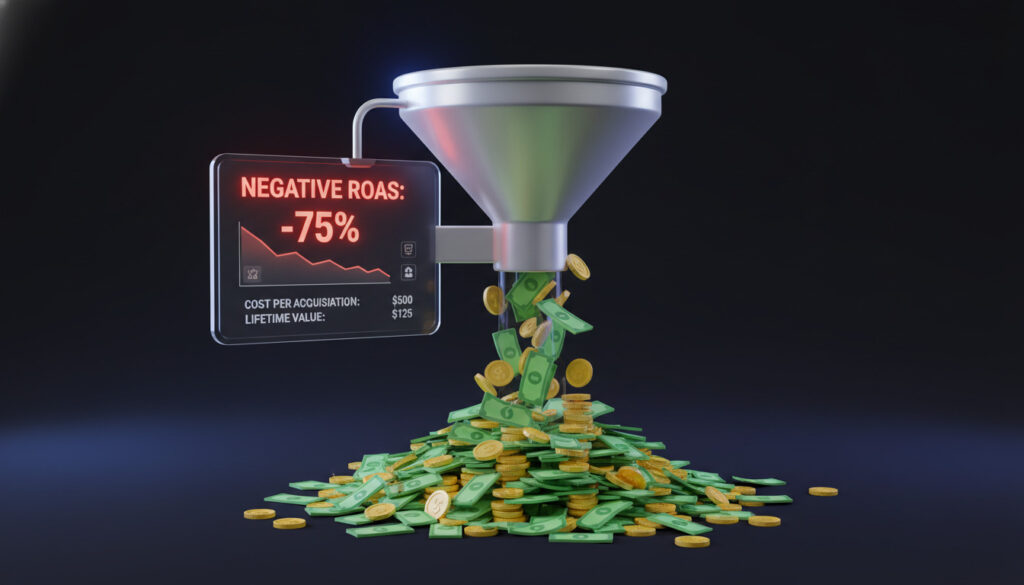
If you are a business owner in the coaching or consulting space, you have likely been told that you are just “one ad away” from a breakthrough. This is the most dangerous narrative in the industry. It keeps you focused on the top of the funnel while the bottom of your funnel is leaking cash.
When a coaching business experiences negative ROAS, the gut reaction is usually to blame the lead quality. “The leads are trash,” “They have no money,” or “They’re just tire-kickers.” While these statements might be true, they are symptoms, not the disease.
The reality is that your marketing is likely attracting exactly who you are asking for. If you optimize for clicks, you get clickers. If you optimize for “cheap leads,” you get people looking for free handouts. The problem isn’t the traffic; it’s the delta between your marketing promises and your sales execution. You are likely running a high-volume, low-intimacy machine in a market that has become entirely immune to standard internet marketing tactics.
Why would a sophisticated buyer respond to a generic “Value-Video-to-Call” funnel in 2026? They wouldn’t. They’ve seen it a thousand times. If you are selling an ₹8,50,000 transformation using ₹850 logic, the math will never settle in your favor.
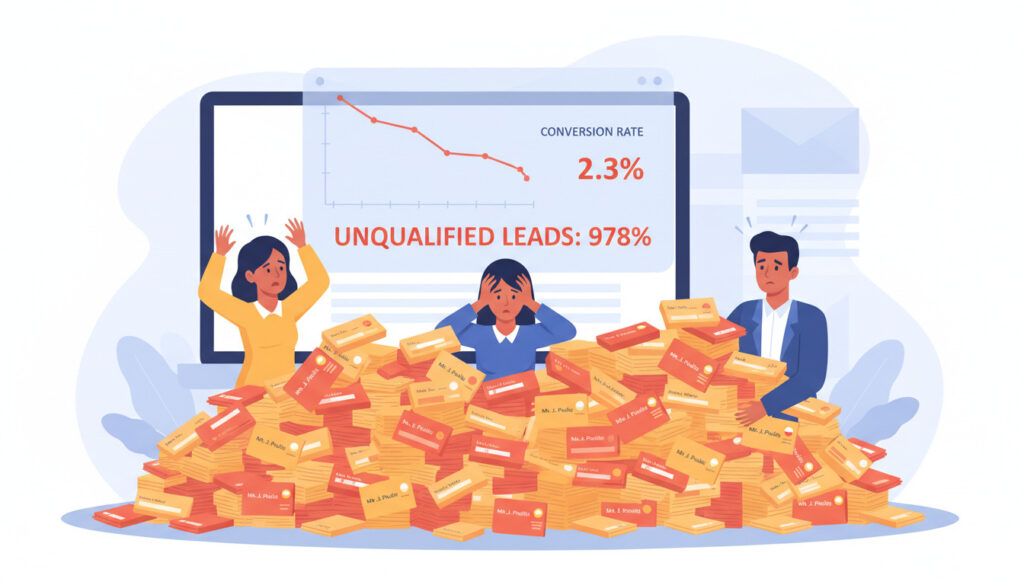
The reason most coaching businesses fail to scale past the ₹40,00,000 to ₹50,00,000 per month mark is a phenomenon I call The Lead Velocity Trap.
We have been conditioned to believe that more leads always equal more revenue. In the early stages of a business, this is often true. You need volume to find your footing. But as you attempt to scale, a strange thing happens: lead quality naturally degrades. As you move from your “warm” audience into “cold” algorithmic traffic, the level of intent drops significantly.
If your internal systems aren’t designed to filter for intent rather than just interest, your sales team will inevitably drown. They will spend 80% of their day talking to people who can’t afford your help, don’t have the problem you solve, or simply wanted to “pick your brain.”
This is where your ROAS dies. It dies in the Cost of Inefficient Conversations. Every hour your high-ticket closer spends on a “discovery call” with a non-buyer is an hour that costs you tens of thousands of rupees in payroll and opportunity cost. When you add the cost of the lead to the cost of the wasted labor, your profit margins vanish.
Are you running a coaching business, or are you running an expensive call center for the curious?
To fix a negative ROAS, you must stop looking at marketing as a “getting” activity and start looking at it as a “filtering” activity. Professional conversion optimization is about repelling the 95% of people who will waste your time so you can focus 100% of your energy on the 5% who are ready to buy.
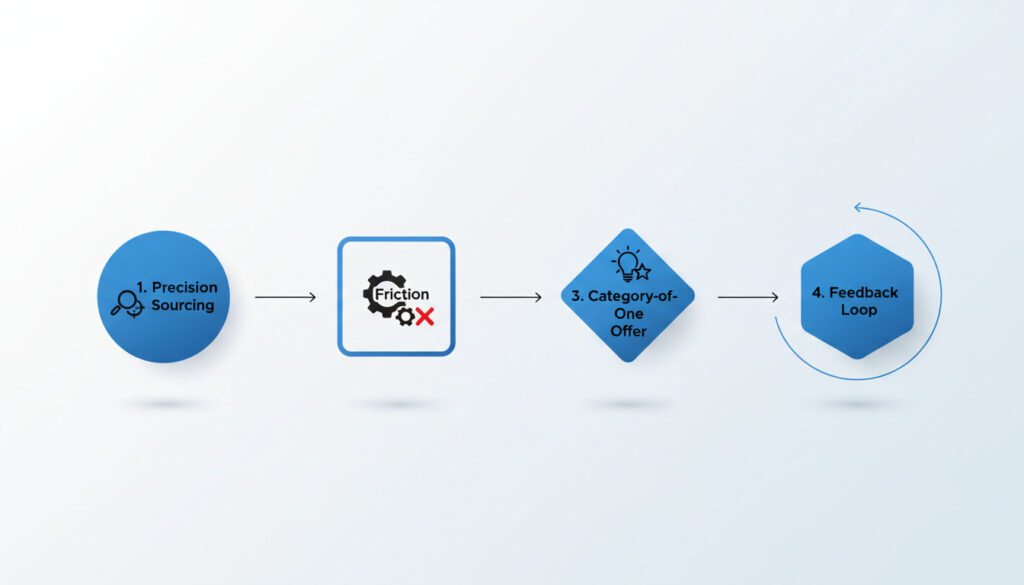
We use a four-step framework to turn bleeding accounts into profit engines.
Stop optimizing for the “Cheap Lead.” In the coaching world, a lead is not a lead.
While the ₹4,500 lead looks “expensive” on your ad dashboard, they are infinitely cheaper in the long run. We shift the focus from Lead Volume to Qualified Intent Volume. This requires increasing the “friction” on the front end. You must force the prospect to trade time and attention for the right to speak with you. If they won’t watch a 20-minute video explaining your process, they will never commit to a six-month coaching program.
Most coaches are terrified of friction. They want the “one-click” booking experience. They make it as easy as possible to get on their calendar.
This is a massive strategic error.
By adding strategic hurdles—multi-step applications, mandatory pre-call homework, and “disqualification” language in your copy—you force the prospect to sell themselves to you before the call even begins.
Friction is your best friend. It acts as a natural separator. If a prospect isn’t willing to spend 10 minutes filling out a detailed application, they are telegraphing that they aren’t serious about solving their problem. By the time a lead reaches your sales team, they should feel like they have “earned” the spot on the calendar. This shift in power dynamics alone can increase closing rates by 40%.
Negative ROAS is often a symptom of a “Commodity Offer.” If you are a “Business Coach,” “Life Coach,” or “Sales Trainer,” you are competing on price, personality, and proximity. You are a commodity.
To fix the math, you must pivot to a Unique Mechanism. You do not sell coaching; you sell a specific, proprietary process that solves a high-value, painful problem. When you are the only person who does “The Delta-4 Architecture” or “The Churn Reduction Protocol,” price resistance vanishes. You are no longer compared to other coaches; you are compared to the cost of the problem staying unsolved.
High ROAS is a byproduct of being the only logical solution to a specific pain point.
In most failing coaching businesses, the marketing team and the sales team live in two different worlds.
The Media Buyer is happy because CPLs are down. The Sales Rep is miserable because the calls are low-quality. The Business Owner is confused because the bank account isn’t growing.
The Delta-4 framework mandates a daily feedback loop where sales data—not “lead” data—dictates the ad spend. If a specific ad set is producing ₹250 leads that never show up for calls, we kill it immediately, regardless of how “well” it’s performing on the dashboard. We optimize for Revenue per Lead, not Cost per Lead.
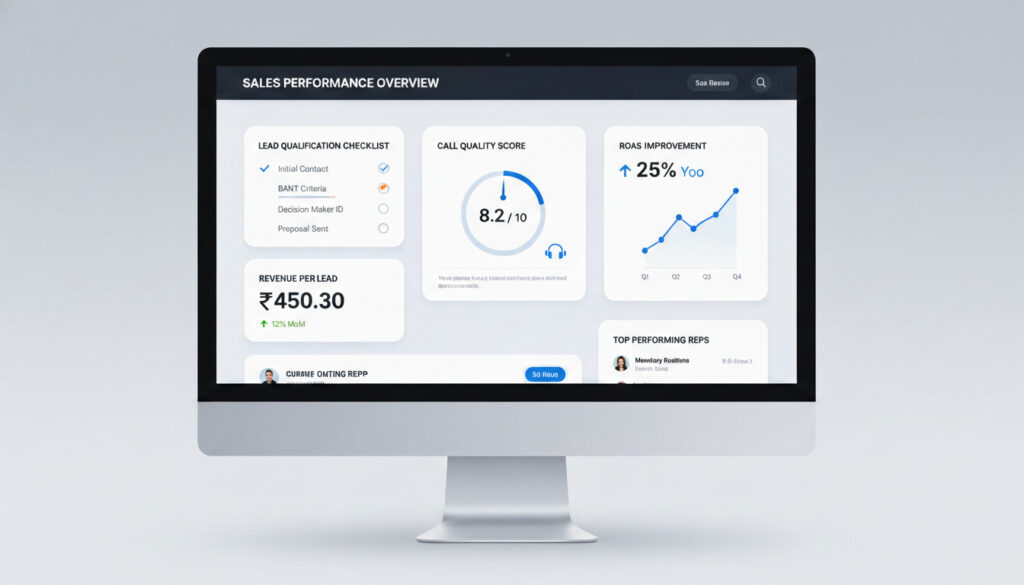
If you want to stop the bleeding and start seeing green on your dashboard, implement these seven tactical shifts today. These are not “hacks”; they are fundamental shifts in how you handle your pipeline.
Start your landing page or your ad copy with a disqualifier. Example: “Do not read this if you are looking for a get-rich-quick scheme or if you aren’t currently doing at least ₹15,00,000 per month in revenue.” By pushing away the wrong people, you become magnetically attractive to the right ones. Authority is built on what you say “no” to.
If a lead doesn’t book a call within 48 hours of opting in, stop wasting your sales team’s time on manual follow-up. Move that lead into a long-form, automated “indoctrination” sequence. If they don’t engage with your content, they aren’t ready for a human conversation. Save your human capital for the highest-leverage opportunities.
Every person who books a call must be sent a specific case study, a technical whitepaper, or a “Masterclass” video. Include a simple line in your booking confirmation: “Our specialists will review your application. If you haven’t watched the video below before the call, we will have to reschedule to ensure we don’t waste your time.” This sets the tone that your time is valuable and that you are the prize in the relationship.
Your ads shouldn’t sell a “Free Strategy Session.” Everyone knows that a free strategy session is just a sales pitch in a cheap suit. Instead, sell the solution or the insight. The call should be positioned as the “Logistics and Implementation” phase for people who are already sold on the method.
Automation is great, but a single, personalized text can save your ROAS. “Hey [Name], I’m reviewing your application for tomorrow. I noticed you mentioned [Specific Pain Point]. Just to be sure, are you looking for a temporary band-aid or a permanent system? We only handle the latter.” This forces the prospect to verbalize their commitment. If they give a weak answer, cancel the call.
Mention a price range or a “significant investment” requirement in your VSL (Video Sales Letter). Yes, your lead volume will drop by 50%. But your “No-Money” objections will drop by 90%. If your ROAS is negative, you don’t need more calls; you need better calls.
Establish a “One Strike” policy. If someone misses a call without 24 hours’ notice, they are blacklisted from your calendar for 30 or 60 days. When you treat your time as a scarce and valuable resource, your prospects will do the same.
“Won’t adding all this friction kill my lead flow?” Yes, absolutely. And that is exactly why you will finally start making money.
You have been sold a lie that “more is better.” In a high-ticket coaching model, “more” is often the enemy of “profit.” If you have 100 leads and make 2 sales (a 2% conversion rate), you are exhausted and broke. If you have 20 leads and make 6 sales (a 30% conversion rate), you are energized and wealthy. Friction is the filter that allows you to focus on the 30% instead of the 2%.
“My market is too saturated for these high prices.” Saturation is a myth for those with a Unique Mechanism. It only exists for people who look, talk, and act like every other coach on the internet. If you are struggling with “price shoppers,” it’s because you haven’t given them a reason to value you beyond your hourly rate. High ROAS isn’t about being the cheapest; it’s about being the most certain.
“Shouldn’t I just hire a better agency or media buyer?” The best media buyer in the world cannot save a mediocre offer or a broken sales process. Media buying is just amplifying what you already have. If you amplify a broken model, you just lose money faster. You must fix the architecture of the conversion before you turn up the volume of the traffic.
Consider the case of a high-level consultant working in the corporate leadership space. For months, he was spending ₹17,00,000 a month on ads to generate roughly ₹30,00,000 in revenue. Once you factored in the cost of his sales reps, his overhead, and his taxes, he was effectively working for free. He was “successful” by top-line standards, but he was drowning.
We didn’t change a single headline in his ads. We didn’t touch his target.
Instead, we changed his Lead Qualification Logic. We implemented the “Friction Filter.” We required a 15-minute “homework” video before the call. We moved his offer from “Leadership Coaching” to an “Executive Retention System.”
The result? His lead volume dropped by over 60%. His sales team initially thought the business was dying. But within six weeks, his revenue climbed to over ₹80,00,000 a month. His ROAS went from a precarious 1.75x to a dominant 4.75x.
He wasn’t talking to more people. He was talking to the right people, and because he was the only one offering that specific “Retention System,” he was able to double his prices without a single objection
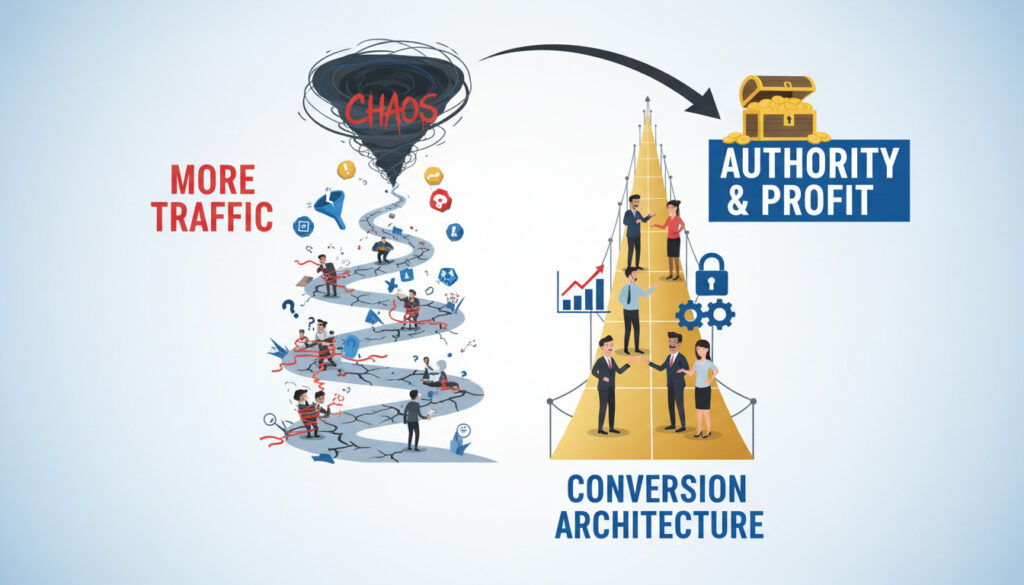
You can continue to play the “more traffic” game. You can keep tweaking your button colors and testing new ad hooks every Tuesday. You can keep hoping that the next “algorithm update” will magically solve your profit problems.
Or, you can acknowledge that the market has shifted.
The “guru” era of high-volume, low-quality mass marketing is over. We have entered the era of Conversion Architecture. In this new landscape, authority is the only currency that matters, and friction is the only tool that preserves it.
Negative ROAS is not a tragedy; it is a signal. It is your business telling you that your intimacy-to-scale ratio is broken. It is a demand for you to stop acting like a solicitor and start acting like an authority.
If you are tired of “buying” revenue and ready to start building a high-margin, high-authority profit engine, it is time to change your model. I don’t do “guru” hype. I don’t care about “crushing it.” I care about math.
Fill up the details below, make sure to give an active Email Id as you’ll receive the Ebook there.
NOTE: Don’t worry, we wont spam your Inbox.